The Mysteries of Dark Matter: What We Know and What We're Still Discovering
- Mar 10, 2023
- 4 min read
If you've ever looked up at the night sky and wondered what lies beyond the stars, you're not alone. For centuries, humans have been captivated by the mysteries of the universe, and perhaps none is more intriguing than the enigma of dark matter. In this article, we'll explore what dark matter is, why it matters (pun intended), and what scientists are doing to unravel its secrets.

"Dark matter is distributed in the universe in a net-like pattern(Image credit: NASA/JPL-Caltech)"
What is Dark Matter?
First things first: What exactly is dark matter? Well, to put it simply, it's stuff that we can't see. Unlike the matter we're familiar with - the stuff that makes up stars, planets, and everything else in the visible universe - dark matter doesn't interact with light, which means we can't observe it directly.
So how do we know it exists? Scientists have inferred the existence of dark matter based on its gravitational effects on visible matter. Think of it like this: If you've ever seen a ship moving through the water, you can see the waves it creates even if you can't see the ship itself. In the same way, dark matter creates gravitational waves that we can observe even though we can't see the matter itself.
Why Does Dark Matter Matter?
If you're not a scientist, you might be wondering why dark matter matters (again, pun intended). Well, for one thing, it makes up a significant portion of the universe - as much as 85% of all matter, according to some estimates. That means that understanding dark matter is essential to understanding the universe as a whole.
But perhaps even more intriguing is the fact that dark matter could hold the key to some of the biggest questions in physics. For example, why is the universe expanding at an accelerating rate? What is the nature of gravity? And could there be other forms of matter and energy that we haven't even discovered yet? By studying dark matter, scientists hope to unlock the answers to these and other mysteries.
The Hunt for Dark Matter
So how do scientists go about studying something they can't see? Well, it's not easy, but they've come up with some pretty clever methods. One approach is to look for indirect evidence of dark matter, such as the gravitational lensing we mentioned earlier. Another is to search for particles that could be dark matter candidates, such as weakly interacting massive particles (WIMPs) or axions.
But so far, the search for dark matter has been largely fruitless. Despite decades of research and numerous experiments, we still haven't found definitive proof of its existence. That hasn't stopped scientists from trying, though - in fact, they're more determined than ever to solve the dark matter puzzle.
The Promise of Dark Matter Energy
One of the most exciting prospects of understanding dark matter is the potential for harnessing its energy. Scientists believe that dark matter particles could be used to generate vast amounts of energy, much like nuclear power or fossil fuels. If we can figure out how to capture and convert dark matter energy, it could revolutionize the way we power our lives. Here's the basic idea: dark matter is all around us, and it exerts a gravitational pull on regular matter. If we could figure out a way to convert that gravitational energy into electrical energy, we could potentially generate vast amounts of power without having to burn fossil fuels or rely on other non-renewable sources.
Now, before you go running off to start your own dark matter power plant, I should note that this is all still very much in the realm of science fiction. We don't yet know enough about dark matter to even begin to think about how we might harness its energy. But the idea is intriguing, and it's certainly worth exploring.
One potential way to generate electricity from dark matter is through something called a "gravitational wave generator." This is a device that would use the gravitational waves generated by dark matter interactions to generate electrical energy. It's a bit like a wind turbine, except instead of wind, it's using the energy of dark matter.
Of course, building a gravitational wave generator is easier said than done. It would require a deep understanding of the nature of dark matter, as well as some pretty advanced engineering skills. But who knows - maybe one day we'll be able to figure it out.
In the meantime, we'll just have to keep searching for dark matter and hope that one day we'll be able to unlock its full potential. And who knows - maybe we'll discover something even more amazing than the idea of using it to power our homes and businesses. After all, the universe is full of surprises, and the search for dark matter is just one of many fascinating mysteries waiting to be uncovered.
The Future of Dark Matter Research
As technology advances and our understanding of the universe deepens, scientists are hopeful that we'll eventually crack the mystery of dark matter. There are a number of new experiments and telescopes on the horizon that could provide new insights into the nature of dark matter, such as the Large Hadron Collider, Large Synoptic Survey Telescope (LSST), James Webb Space Telescope, and the Euclid space telescope. These instruments will allow us to observe the effects of dark matter on galaxies and clusters of galaxies with unprecedented precision, which could help us narrow down the search for dark matter particles.
But even if we do find evidence of dark matter, the search won't be over. We'll still need to figure out how to harness its energy and unlock its full potential. It's an exciting prospect, but it's also a daunting one - the challenges of understanding dark matter are immense, and there's still so much we don't know. But that's the thing about science - sometimes the answers aren't easy or immediate, but the pursuit of knowledge is always worth it.
Conclusion
In conclusion, dark matter is one of the most fascinating and perplexing mysteries of the universe. It's a subject that has captivated scientists and amateur stargazers alike for decades, and it shows no signs of losing its allure anytime soon. While we may not have all the answers yet, the search for dark matter continues to drive scientific discovery and push the boundaries of our knowledge. And who knows - maybe one day we'll finally be able to unlock the secrets of this elusive substance and use it to power our world in ways we can't even imagine.
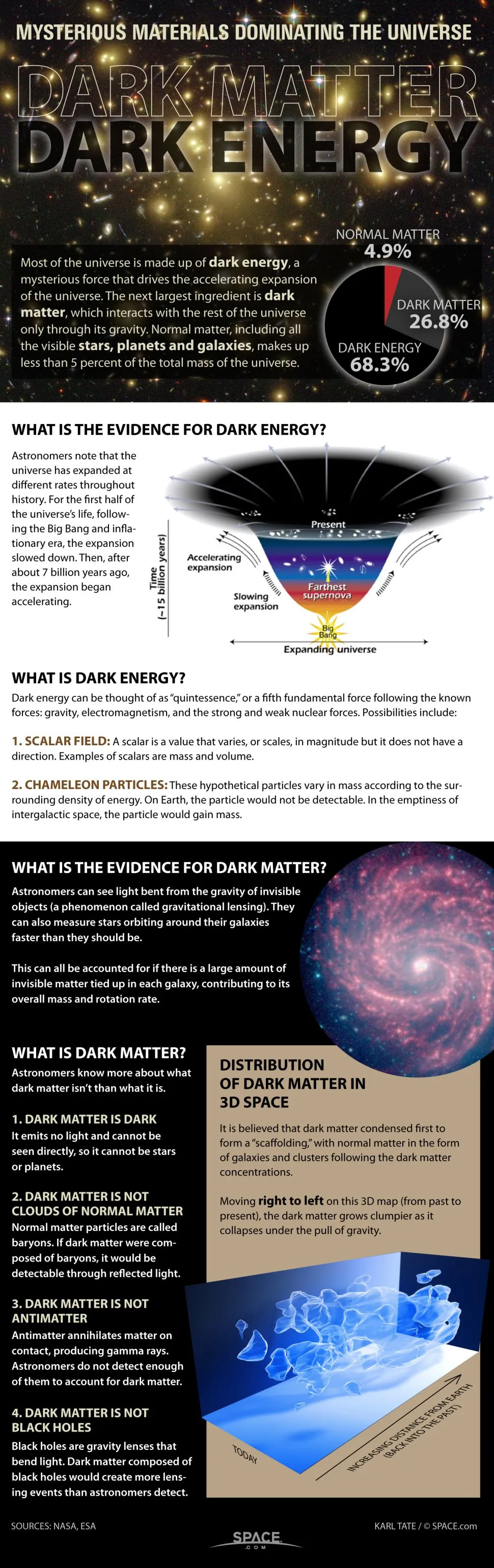
(Image credit: Karl Tate/Space.com)


Comments