The General Theory of Relativity - Simplified
- Mar 12, 2023
- 4 min read
Have you ever wondered about the nature of space and time? How does gravity work, and why do objects move the way they do? For centuries, scientists and philosophers have grappled with these questions, but it was Albert Einstein who revolutionized our understanding of the universe with his General Theory of Relativity.
In this article, we'll take a journey through time and space to understand the General Theory of Relativity and its implications for our understanding of the universe. But before we dive in, let's take a step back and understand what led Einstein to develop this groundbreaking theory.
Einstein's Theory of Special Relativity
In 1905, Einstein introduced his Theory of Special Relativity, which fundamentally changed our understanding of space and time. Prior to this theory, physicists believed that space and time were separate and absolute entities, independent of each other. However, Einstein showed that they were actually intertwined, forming a four-dimensional fabric known as spacetime.
One of the key tenets of Special Relativity is that the speed of light is constant, regardless of the observer's frame of reference. This means that if you're moving towards a beam of light, you won't measure it as traveling any faster than if you were stationary. This seems counterintuitive, but it has been confirmed by numerous experiments.
Another consequence of Special Relativity is that time appears to slow down for objects moving at high speeds. This phenomenon, known as time dilation, has been observed in experiments with high-speed particles. It also has implications for the behavior of clocks in a gravitational field, as we'll see later.
Einstein's Theory of General Relativity

Special Relativity was a significant breakthrough, but Einstein was not satisfied with stopping there. He believed that there must be a deeper connection between space, time, and gravity, and he spent the next ten years developing his Theory of General Relativity.
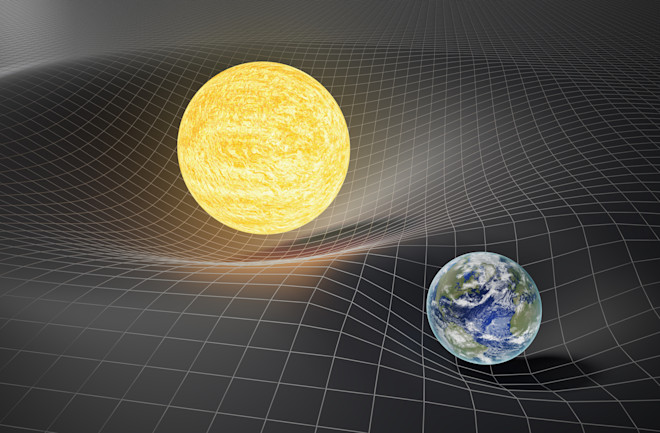
The key insight behind General Relativity is that gravity is not a force that acts between two objects, but rather a consequence of the curvature of spacetime. In other words, massive objects like stars and planets warp the fabric of spacetime, and other objects move along the curves created by this warping. This is known as the curvature of spacetime.
To understand this concept, imagine placing a heavy ball on a trampoline. The ball will create a depression in the fabric of the trampoline, and any smaller objects placed nearby will roll towards it. In the same way, a massive object like a star will create a "dimple" in the fabric of spacetime, and other objects will be attracted to it.
One consequence of General Relativity is that time appears to run slower in a stronger gravitational field. This is known as gravitational time dilation and has been observed in experiments with high-altitude clocks. It also has implications for the behavior of light in a gravitational field, as we'll see later.
Another implication of General Relativity is that light will bend when it passes through a gravitational field. This was famously confirmed by Arthur Eddington during a solar eclipse in 1919, when he observed that the light from distant stars was bent as it passed close to the sun.
General Relativity and Black Holes
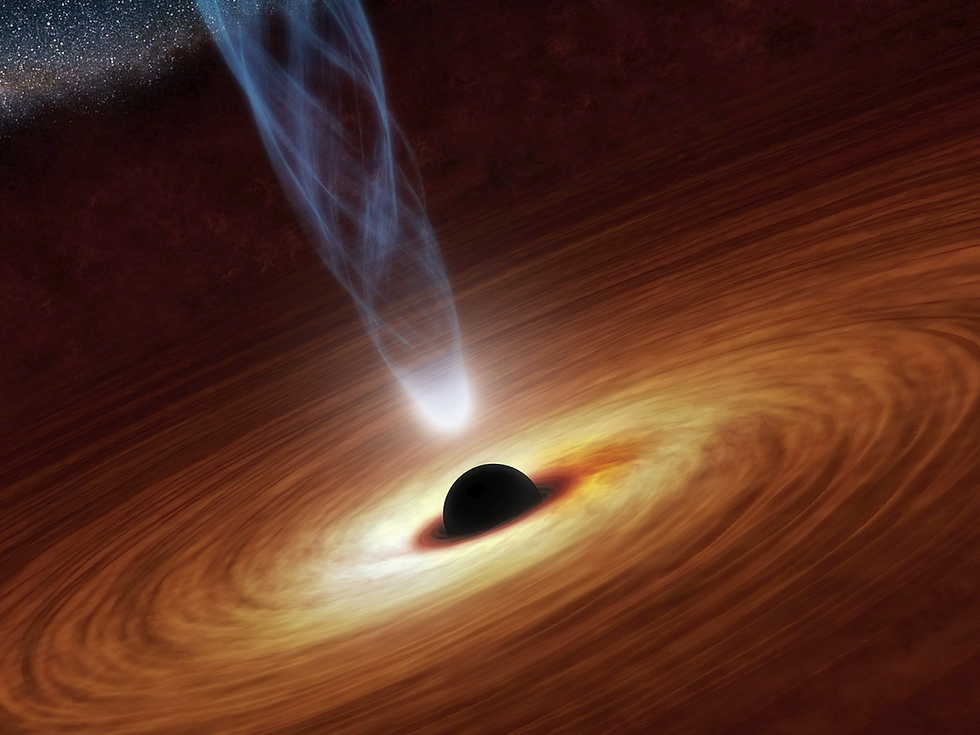
General Relativity has important implications for the behavior of black holes, which are objects with such strong gravity that nothing can escape their grasp, not even light. According to General Relativity, the intense gravity of a black hole warps spacetime so severely that it creates a point of no return, known as the event horizon.
At the event horizon, the escape velocity is equal to the speed of light, which means that anything that crosses it is doomed to fall into the black hole. The gravitational pull is so strong that time appears to stand still, and nothing can escape the pull of the black hole.
The General Theory of Relativity predicts that the gravity of a massive object, such as a planet or star, can warp the fabric of space and time. This warping effect causes objects to move on a curved path, rather than a straight line, when they are near a massive object. This is what we experience as the force of gravity. The warping of space and time is caused by the curvature of spacetime, which is determined by the distribution of matter and energy in the universe. Einstein's equations for the curvature of spacetime show that massive objects cause a bending of space and time, which in turn affects the motion of other objects in their vicinity.
One of the most fascinating predictions of the General Theory of Relativity is the existence of gravitational waves. Gravitational waves are ripples in the fabric of spacetime that are generated when massive objects move. These waves travel at the speed of light and are incredibly difficult to detect, but they have been observed by astronomers using sophisticated instruments such as the Laser Interferometer Gravitational-Wave Observatory (LIGO).
Another consequence of the General Theory of Relativity is the phenomenon known as gravitational lensing. When light from a distant object passes by a massive object, such as a galaxy or a cluster of galaxies, the light is bent by the gravitational field of the massive object. This causes the distant object to appear distorted or magnified, depending on the geometry of the situation.
The General Theory of Relativity has been confirmed by numerous experiments and observations over the past century, and it is now considered one of the pillars of modern physics. Its predictions have been tested in extreme conditions, such as near black holes and neutron stars, and have always been found to be in agreement with observations.
In summary, the general theory of relativity is a groundbreaking scientific theory that has revolutionized our understanding of space and time. Einstein's theory states that gravity is not a force that is transmitted between objects but rather a curvature of spacetime caused by the presence of mass and energy. Just like how a bowling ball on a mattress creates a dip, a massive object creates a dip in spacetime. This curvature of spacetime affects the motion of objects and how time passes, leading to the phenomenon we experience as gravity.
To put it simply, you can think of spacetime as a stretchy fabric. Massive objects like planets and stars create a dip in this fabric, and smaller objects like satellites and humans move along the curves created by the dips. The bigger the object, the deeper the dip, and the stronger the gravitational pull. Just like how a ball rolling on a stretchy fabric will move towards a dip, objects in space will move towards massive objects due to the curvature of spacetime.


Comments