Hawkins Radiation: A Mind-Bending Concept
- Mar 12, 2023
- 5 min read

Surely you have heard that black holes don't emit anything, even light can't escape from them! But what if there is a peculiar sort of radiation, one whose origin lies in quantum mechanics, that defies even this logic and is emitted from black holes?
The core of Hawking radiation is that it describes the process of hypothetical particle formation near a black hole’s boundary. The term ‘hypothetical’ is of key importance here and we will look more into it as we go further. The radiation also has another important consequence: A black hole’s temperature is inversely proportional to its mass. In simple words, this means that the larger a black hole is the cooler it is and vice versa.
Though the peculiar thing about this radiation is that it relies on the principles of both general relativity and quantum mechanics. As context, these two fields are long since thought to be irreconcilable. Our calculations breakdown whenever we try to find a way to apply both of them at a single phenomenon. Surprisingly, black hole radiation is one of the rare processes that are based on application of both giant fields.
Radiation was first proposed by Stephen Hawking in 1974 and although it has been widely discussed since then, its experimental confirmation is still debatably due. If in the future we do confirm it, we can be sure that black holes can emit energy and shrink in size with time.
Why should black holes glow?
Our key to understanding this question is entropy. Put simply, it is merely the measure of disorder in our universe. The second law of thermodynamics states that entropy and thus disorder should only increase with time. Imagine it like a cup proceeding to fall and break into pieces. It goes from an ordered state to a disordered one, thus following the law. Indeed the reverse would mean the violation of this fall and this doesn’t happen; broken cups going back to their original states is hardly a common occurrence.
Looking more closely at black holes we can see that since they ‘absorb’ matter and thereby remove it, they should decrease the entropy of universe making it less disordered. If this were true then it would be a direct violation of thermodynamics. Also the boundary of a black hole, called the event horizon should be most affected by absorption of matter. Naturally, a person would expect it to increase in area with every mass that falls in. Jacob Bekenstein proposed that a possible way to conserve thermodynamics would be by imagining that the increased area should represent entropy that would’ve been lost. Hawking further expanded on this by saying that if the event horizon is imagined to have an entropy then it should also glow, since entropy is another way of describing heat energy.
Hawking initially thought to disregard Bekenstein’s proposal because a glowing black hole wouldn’t really be a black hole in strict sense. Instead, he later went on to discover that black holes actually do shine with cold light!
How do black holes produce Hawking radiation?
We will not exaggerate, the actual mechanism behind the emission of radiation from event horizon is a complex one that requires immaculate understanding of advanced sciences. But that does not mean we can’t explain the intuitive idea behind it.
We all know the basic and ever-constant rule of cosmos: Energy is always conserved. We start by expanding along this. In quantum mechanics, vacuum isn’t actually empty. Instead it is full of positive and negative particles forming and annihilating each other at instantaneous speed. It is much like how you would describe zero as the sum of negative and positive one. Rather than calling zero ‘nothing’, we imagine it to be the result of countless negative and positive equal numbers colliding.
The Black-Hole Information Paradox
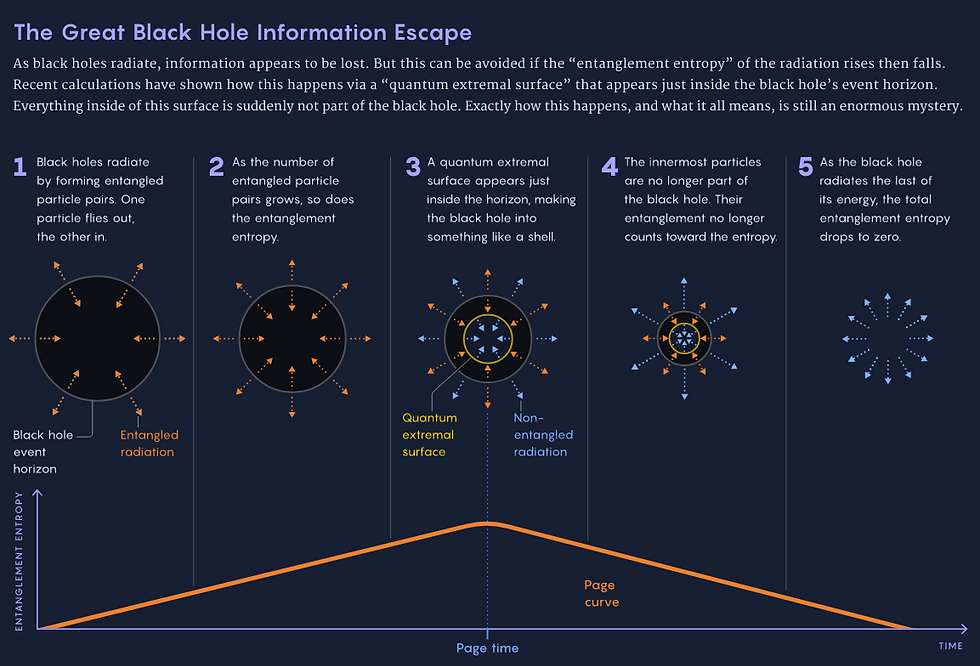
Ah, the black hole information paradox! It's the ultimate head-scratcher, a real conundrum that's been stumping astrophysicists for decades. To understand it, let's go back to the basics.
As we've discussed, when matter gets sucked into a black hole, it's gone for good. Poof, vanished into the singularity, never to be seen or heard from again. This seems like it would be no big deal - I mean, who really cares if some gas and dust gets gobbled up by a cosmic monster, right? But here's the thing: according to the laws of physics, information can never be destroyed. So what happens to all that data - the mass, the energy, the spin, the charge - when it falls into a black hole?
This is where things get tricky. If the information is truly gone forever, that would violate the laws of quantum mechanics. But if the information is somehow preserved, that would contradict the idea that black holes destroy everything that falls into them. It's a classic catch-22, a real mind-bender that has left many scientists scratching their heads.
So, how does this connect to Hawking radiation? Well, remember that radiation carries away energy and mass from a black hole. In other words, it's a way for a black hole to lose some of the information that it's absorbed. But here's the rub: the radiation itself doesn't contain any information about what fell into the black hole. It's completely random and chaotic, with no way to reconstruct what got swallowed up in the first place.
So, what's the solution to the paradox? That's still an open question, and it's one of the hottest topics in modern astrophysics. Some researchers believe that there might be a way to recover the information from the radiation after all, while others think that the paradox might be a sign that our current understanding of physics is incomplete. Personally, I like to think that the answer involves a time-traveling cyborg from the future, but that's just me. Hey, stranger things have happened in the cosmos!
That's a wrap!
So, that's Hawking radiation for you, people! It's a bizarre phenomenon that can make even the smartest physicist's head spin. But it's also a testament to the incredible complexity and beauty of our universe. The fact that we can have something as strange as a black hole, emitting hypothetical particles and glowing with cold light, is truly mind-boggling.
Of course, there's still a lot we don't know about Hawking radiation. We're still searching for ways to detect it experimentally and confirm its existence. And the information paradox looms over us, reminding us that there are still many mysteries of the universe waiting to be solved.
But for now, we can appreciate the brilliance of Stephen Hawking's insights and the way he brought together two seemingly incompatible fields of physics. And who knows, maybe one day we'll even find a way to harness the power of Hawking radiation for our own purposes. A giant space heater, perhaps?
In any case, the study of Hawking radiation and black holes is a reminder of how much we still have to learn about the universe around us. So keep asking questions, keep exploring, and who knows what kind of weird and wonderful discoveries we'll make next!


Comments