Schrodinger’s Cat
- Nov 26, 2022
- 3 min read
Updated: Nov 29, 2022
Can you imagine to be both alive and dead at the same time?
What kind of an absurd question is that?
Well, a thought experiment that played one of the most important roles at the early stages of quantum mechanics is very much based on this absurd question.
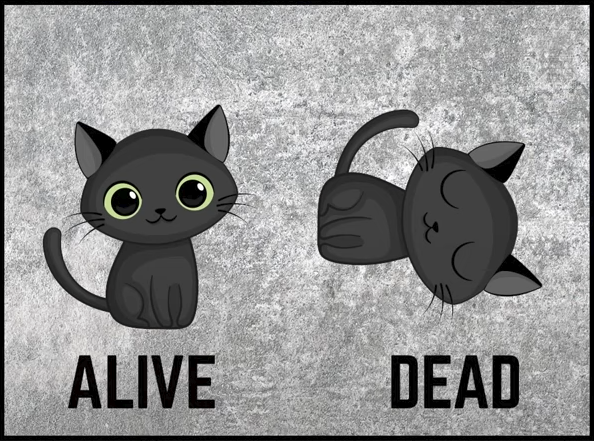
Schrödinger’s cat is a simple thought experiment devised by Erwin Schrödinger in 1935 as an attempt to refute the claims made by the Copenhagen Interpretation of Quantum Mechanics. This Interpretation provided with an explanation of the “behavior” of Quantum Mechanics. It stated that the quantum particles (particles smaller than atoms) did not exist in the same as real world objects and rather existed in a superposition of states. In simplified terms, physicists in Copenhagen believed that quantum particles simultaneously existed in multiple states, and it is only when a particle had been observed that it existed in one state or the another.
What does this even mean?
Yes, I understand that this might sound quite confusing to you at first but don’t worry as I have explained this concept in further detail with an interesting analogy here. Schrödinger thought this interpretation of flawed and came up with his iconic cat experiment, in the paper titled” The Present Situation in Quantum Mechanics”, to illuminate the farcicality of the Copenhagen scientists.
One version of the thought experiment goes something like this. Imagine you locked up a cat in a box that is completely cut off from the outside world along with a live explosive that has a 50/50 chance of blowing up after an hour. In other words, if you open the box after one hour, there is an equal probability of finding the cat dead or alive. However, there is no way to know before the box is opened if the cat is alive or not.
Ok but what’s the catch?
Well, according to Quantum Mechanics, until the box is opened, the cat exists in a superposition of states – both dead and alive simultaneously. Once you open the box, you “force” the nature to collapse, resulting in one definite outcome as it is explained is this YouTube video. This “nature” is what is called a wave function. The scientific specifications of a wave function is beyond the scope of this article, but to just clear our understanding you can think of a wave function as a function that contains information about the quantum particles’ properties like momentum, position, time, and spin. It basically describes the existence of the quantum particle. For a deeper understanding of wave functions, I urge you to check out this wonderful yet simple video by The Science Asylum.

This experiment might appear to be eccentric, but it was just an attempt by Schrödinger to strike a blow against the Copenhagen Interpretation and Neils Bohr during a time of intense debates and arguments in the scientific community. He argued that the concept of superposition was ridiculous because the cat cannot possibly be both alive and dead at the same time. It just didn’t make sense. However, as silly as this interpretation of quantum mechanics sounds, it was later found out to be true and that quantum particles do exist in a superposition of states until measured.
But wait a minute, how does my act of looking cause the nature to collapse into one outcome? The cat was already alive or dead in the box before I opened it. I didn’t change anything!
Yes, but that is from your perspective, what about the cat? The cat either experiences the explosive blow up or it doesn’t and stays alive. Because the cat can see what’s actually happening inside the box, its experience is entangled or linked to the final outcome of the experiment. This idea of entanglement is known as quantum entanglement – the idea that even made a physics genius like Einstein incredibly uncomfortable.
While this seemingly silly experiment was never actually carried out, it played a huge role in understanding the world of quantum mechanics. Moreover, this experiment is one of the many reasons that led the 2022 trio of Physicists, John F. Clauser, Alain Aspect, and Anton Zeilinger, to win a Nobel Prize in physics. A single cat theory was strong enough to make us realise that the universe is even stranger than we thought and contributed to the theory of Infinite parallel universes.


Comments